
FREE SHIPPING ON ORDERS $75+ IN THE U.S.
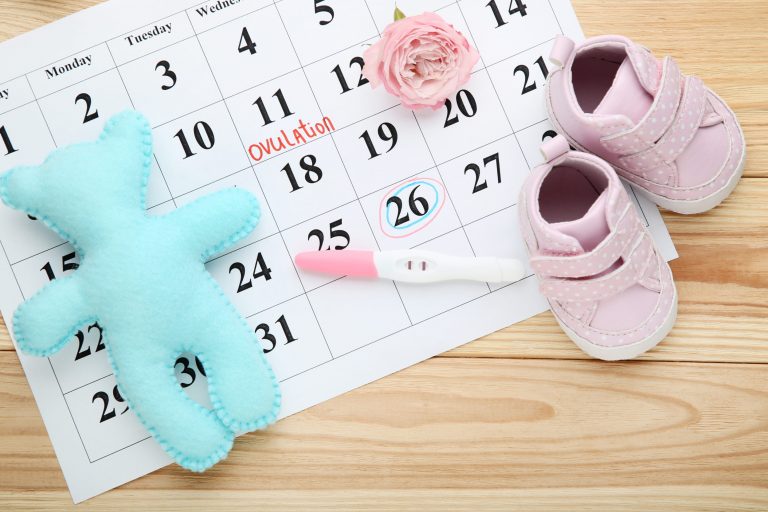
Everyone knows that in order to get pregnant, sex needs to happen. Not everyone knows that you have to have sex at just the right time to make it happen! If you think back to your middle school biology or health class, you’ll remember that in order for pregnancy to occur, a sperm fertilizes a woman’s egg, and the egg must be implanted in the lining of the uterus.
Ovulation is the process when an egg is released from the ovary. This egg moves into the fallopian tube where it awaits fertilization by a visiting sperm. If the egg leaves the fallopian tube – typically 12-24 hours after ovulation, a woman is no longer able to get pregnant on this menstrual cycle. A woman is fertile for a 3-6 day period before ovulation.
Ovulation typically occurs mid-way through the cycle. So a woman with a typical cycle of 28 days, will ovulate on Day 14 of her cycle (Day 1 of the new cycle being the first day of her period). A woman with a 29 day cycle will typically ovulate on Day 15, a 30 day cycle Day 16, etc.
Sperm can live inside a woman’s body for up to 5 days! Ovulation is not necessarily like clockwork either, so having sex on any of your fertile days increases the chance of pregnancy as there will be sperm waiting for the egg to release. You are most fertile the 3 days surrounding your ovulation date since ovulation can be a day or two early or late.
Not talking about a temperature taken at your forehead, but your basal body temperature (BBT) taken using a special thermometer “down there”. Progesterone produced by your ovaries after ovulation causes the body’s temp to increase by a few tenths of a degree. Studies show that BBT charting can be unreliable, with physicians in one study only able to accurate predict ovulation in 38.1% of patients (Basal body temperature: unreliable method of ovulation detection.)
Higher estrogen can increase the production of saliva. Since there is a large increase in estrogen a couple of days before ovulation, this could be a sign that you’re about to ovulate.
The consistency of discharge from the cervix, or cervical mucus, changes as you get closer to ovulating. It may look clear, slippery, stringy or stretchy – a lot of women compare it to an egg white consistency.
Studies show that libido peaks at ovulation! Increased blood flow and higher estrogen levels are nature’s way of telling you that your body is ready to get pregnant.
These test kits and strips test for the presence of Luteinizing hormone (LH)Hormone produced by the pituitary gland that affects sex organs and plays a role in puberty, menstruation, and fertility. in your urine. A huge surge of the LH Hormone produced by the pituitary gland that affects sex organs and plays a role in puberty, menstruation, and fertility. hormone is what triggers ovulation in about 24-36 hours. Typically you will use a test every day of your cycle to get a baseline which will allow for the tester to correctly identify the LH surge.
Some women report clearer skin, rosier cheeks, and even weight loss during ovulation! Studies show that a woman’s voice may be lower (and sexier) during ovulation, and swing her hips more, all of which men find more attractive.
You can do all the right things with timing, testing and sex, but still not get pregnant for months, or even years. Why?
Each ejaculation from a man contains 30-300 million sperm, but each of these little swimmers has a tough journey to meet an egg. Mortality rate for sperm is quite high, and only a few dozen sperm even make it to the egg. A woman’s vagina is an acidic environment, which is good for fending off bacteria and viruses, but can be bad news for sperm. The first obstacle is cervical mucus which can stop all but the strongest sperm. Once they make it into the uterus, they have a 50% chance of choosing the right fallopian tube. Besides that, it’s a long journey for a sperm to travel through the uterus, to the fallopian tube. Sperm are approximately 0.05 millimeters in length (0.002 inches) and have to travel roughly 18 cm (7.09 inches). The fastest sperm travel at the rate of about 2.5cm (almost 1 inch) every 15 minutes meaning it can take anywhere from 45 minutes to 12 hours for sperm to reach the fallopian tubes.
Women are born with millions of eggs in each of her ovaries. Many eggs will die immediately, and the number of eggs decreases steadily as you age. It’s estimated that by the age of 30, only 72,000 viable eggs remain. Egg quality also declines with age.
Some embryos simply fail to implant in the uterine lining or womb. Researchers found that human embryos produce a chemical called trypsin which signals the womb to prepare its lining for implantation. In a process in which the researchers likened to an “entrance exam”, the womb seemingly has a minimum threshold for this chemical. Embryos with significant genetic abnormalities had altered trypsin signals, and produced a stress response in the womb that made implantation highly unlikely.
Fifty percent of all fertilized eggs are lost before a woman’s missed period.

Of all of the couples trying to conceive:
Experts recommend that you see a doctor or fertility specialist if you have been trying for a year with no success of getting pregnant. In one study, couples that timed intercourse with ovulation had higher success rates!
The older a woman gets, the longer it can take to get pregnant. After about one year of trying:


Sex is Determined the Moment of Conception

Older Women Are More Likely to Release Two Eggs, Increasing the Chance for Twins After Age 35

Once an Egg is Fertilized, it Forms a “Force Shield” to Exclude Other Sperm

Sex Position Doesn’t Matter